Found an Edison recording from 1909 with selections from the operetta "Little Nemo" by Victor Herbert's. Of course it just HAD to be blended with McCay's animation from 1911!!

Here lies the residue of "The Animating Apothecary," a source of obscure ephemera and thoughts. Instagram? see - https://www.instagram.com/animating_apothecary/ also check out asifa.org and asifa.net - content (c) 2006-2026 Jim Middleton (一個古怪的老頭,總是揮舞著雙手,哈哈大笑。or -手を振りながらよく笑うクレイジーな老人 or 손을 흔들며 웃는 미친 노인 )
Showing posts with label history. Show all posts
Showing posts with label history. Show all posts
Thursday, February 20, 2020

Sunday, September 22, 2019
Revisiting Sfumata - Number Two
After completing #1 in 1998, #2 should have been a breeze. After all, it had been begun two years before that, using the unsupported Autodesk Animator Pro, designed for DOS. Well, after 30 seconds and 90 layers, this much was finished. Began with adjusting timing and colors, now that technology permits such luxuries on a budget of $35 and paper clips.
Time to wrap up the last 70%. Let's hope for fewer distractions this time! After all, #3 is becoming impatient.
Saturday, August 04, 2018
Pharmacies in Battle Creek - A BRIEF Historical Overview
last update: 5 August 2018
A Bit of Background
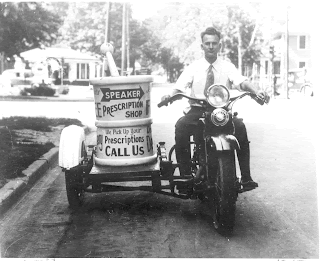
Before the creation of the FDA in 1906, there were no restrictions placed on what could be sold as medicine in the United States. Morphine was a common ingredient in infant teething formulas, asparagus extract was sold as a urinary “purifier,” and even Grape Nuts was touted by C. W. Post as a treatment for appendicitis. Further, no drug company was required to state the ingredients of its products. Overdosing and addiction were common in those “good old days.”. Battle Creek, because of its reputation for health, drew the attention of several companies that set up shop, or at least rented a post office box, to benefit from the distinction of being in the same city as Dr. Kellogg’s Sanitarium.A Bit of Background

Until 1919, Michigan pharmacists were only required to have a 10th grade education and have two years apprenticeship before taking a licensing exam. Licensing of individual drugstores was not required until 1921. Until that time, opening a pharmacy required little more than the willingness to do so. It wasn’t until 1929 that even a two-year college level training was required (present training takes six years).
In the pre-FDA days, Battle Creek boasted over a dozen pharmacies, most of them concentrated around the center of town. Many of them dispensed their prescriptions in elaborate monogrammed bottles, stoppered with the finest Portuguese cork, and sealed with paraffin. The requirements for labeled ingredients imposed upon the patent medicines didn’t apply to compounded prescriptions; in fact, until as late as the mid-1960s it was still considered by many as a violation of the physician-pharmacist working relationship for a pharmacist to discuss medicine with the patient.
As chain pharmacies emerged, gaining strength with preferential pricing and agreements with insurance and drug companies, independent pharmacies found it increasingly difficult to remain competitive and still be profitable. As a result, the baker’s dozen of independent pharmacies that existed in 1978 has dwindled to two in 2001. Their legacy of treating the ill and serving their community will remain in our community’s collective memory.
 |
| Ahmberg and Murphy's Elegant storefront - Kellogg Foundation stands in this location |
Some Random Notes on the Collection at the Kimball House Museum in Battle Creek, Michigan:
(note - this is far from a complete listing of Battle Creek pharmacies - this brochure was developed as a guide to selected artifacts at the museum put on brief display in 2001. The legends surrounding Speaker's pharmacy could fill a book on its own.)
Log Cabin Sarsaparilla, of Rochester NY– sarsaparilla was a general tonic and “cure all” for digestive disorders; simple to make, it often contained high levels of alcohol to “enhance” its absorption and “preserve the ingredients.” Dr. Guysott added yellow dock (then popular for jaundice or constipaton) to his preparation.
The “bitters” from Dr. Sawen’s and Dr. Hostetter’s subscribed to the philosophy that medicine had to taste bad to be good. It didn’t hurt that the compounds were usually 50 proof. Dr. Hostetter made use of an annual almanac to promote his product.

Pine Tree Tar Cordial, again replete with a hefty dose of inebriants, would give the proper impression that the patient was drinking turpentine.
Lydia Pinkham’s Vegetable Compound was the grandmother of all patent medicines; her picture was common to nearly every typesetter’s box. Her written advice to customers, however, was completely posthumous. The product is still made today, although the “preservative” is at a lower concentration.
Buffalo Lithia water came from rich mineral springs during an era where drinking such water was an important part of taking “the cure.” Contemporaries noted the best way to indulge was to “hold your nose and drink quickly.”
Vin Antimony, presented here in a pharmacy’s reagent bottle, was primarily put to use as a cathartic and emetic...for those with the “urge to purge.” Also known as the “tartar emetic.”
The Old Indian Medicine Company, makers of Wa-Hoo Bitters, probably had nothing more than a post office box in Battle Creek. It offered local residents the opportunity to try its concoction at a substantial discount.
Claude C. Jones ran a pharmacy in the old Bijou theatre arcade at 47 West Main (now Michigan) after trying out a location at 115 Calhoun. When the Battle Creek Retail Druggists’ Association organized in 1928, he was its first president.
 |
| Bijou Theater Lobby |
 |
| Bijou Theater becoming a historic parking lot |
E. L. Jones, of 13 East Main, was a “manufacturing chemist” during the 1880s.
M. L. Pierce Palace Pharmacy was a new addition to 53 West Main by 1889. Short-lived by comparison to most, his store didn’t survive to the turn of the century. A similar fate met J. F. Halliday and Sons.
Will Phillips, of 38 East Main, then 10 West Main, then 53 West Main, had moved on completely by 1901.
J. E. Weeks, at 250 East Main, had his name on a pharmacy until at least 1916.
The Health Home Pharmacy was a fixture at 222 West Main for the last two decades of the 19th century.
Willard Drugs of 45 East Main remained in business until around World War I.
Larmour’s Drugs, founded by A. Fred Larmour, originated at 201 South Kendall before moving to Urbandale in the 1930s. It remained the longest operating independent pharmacy in Battle Creek.
The Holton Brothers were doing business at 3 West Main in 1869. A move to 19 East Main (the “Peninsular block”) came four years later. They became Willard Drugs after moving to 45 East Main.
Grandine and Hinman (of 1883 vintage), of 6 East Main, changed billing from Andrus and Grandine, with its heritage also dating to at least 1869. Hinman went off on his own in 1887 to 11 East Main, and the partnership site went to E. J. Smith in 1889...busy pieces of real estate.
F. H. Boos, brewer of “Milwaukee Beer” found action as bottler of ginger ale during Prohibition.
R. W. Snyder had no local pharmacy, but prepared medical supplies (“Spirits of Camphor”) and through its successor, the Alden Brothers, produced “Orange Cider” and “Wild Cherry Phosphate.” The labels are suitable for framing.
The Battle Creek Sanitarium Pharmacy was discreetly secreted into the depths of the San’s basement, emphasizing Dr. Kellogg’s philosophy that drugs were unnecessary in the world of “biologic living.” One San pharmacist, Oscar Speaker, left in 1926 to begin a retail pharmacy at 22 East Main, a site that probably employed every pharmacist in the county at one time or another before it closed in the 1970s.
 |
| Bernard Swonk on the right - a longtime pharmaceutical presence in the cereal city |


 |
| "For Lease" sign in the site of Speaker's Drugs (now demolished - site is "Mill Race" fountain wall) |
❖
2001 research for this project by Jim Middleton, one of the few pharmacists in Battle Creek who didn’t work at Speaker’s Drug Store....but nearly everyplace else that no longer exists.
Saturday, August 08, 2015
Playing with Photoshop - 3D-ish flickerishness
Downtown Battle Creek, 19th century:

Brother Dave as Mr. DNA, ca 1978:

(the separation is a bit too much - this looks like a mutation waiting to happen...)
And, finally, Brother Dave at DisneyWorld, ca 1980 ... when potatoes were whipped only....

And go it soes....
Saturday, June 27, 2015
Elbert Hubbard Dissects Dr. Kellogg and C. W. Post, ca 1905
Elbert Hubbard received fleeting mention in the Winsor McCay film, "Sinking of the Lusitania," as one of the passengers on that ill-fated ship. His background of philosopher was all the film gave; for full credit, he was among the most published men of his time, with volumes of essays and discussions under his belt before his death at 58, even if he had to create a publishing company of his own to do so - Roycroft Press in western New York. What follows is an essay of his, analyzing two of the biggest names in the Surreal City at the turn of the 20th century.
IN BATTLE CREEK, the home of the Breakfast Foods, live two live men. There may be more than two live men in Battle Creek.--I really can not say—but there are only two that are so thoroughly alive that they will live long after they are dead.
Some one has said--out in Utah, I believe—that no house is big enough for two families. Also, we might say that no town is big enough for two big men.
Dr. J. H. Kellogg and Charles W. Post are men of initiative--powerful, restless, nervous, ambitious, opinionated, prejudiced, with ego plus and the Builder's Itch.
This type of man is the only kind that builds institutions and they all have the defect of their qualities.
This article is no paid ad, for sad to relate it will displease both Post and Kellogg, neither of whom will allow the other's name to be mentioned in his presence, unless you sneeze.
Kellogg has impressed himself on the world profoundly. He is hated and loved, scorned and praised, vilified and worshiped. He is a theological-psycho-medico-talkissimus who will write an editorial for a Seventh Day Advent journal, lecture for two hours, diagnose the status of forty patients as fast as a sunrise judge passes judgment on the socially derelict; and then will operate for ten hours without rest.
Through the Kellogg sanitarium pass say, ten thousand patients a year. Some die. A vast majority get well. And some get mad—and these that get mad get well, having received an impetus that stopped introspection and put a kibosh on the messianic instinct, which is simply a search for help outside of yourself.
Life is disillusion. The great man is a sore disappointment, when inspected at close range.
Carlyle said of Jesus Christ, "A great mon, a great mon—but he had his limitations! "
So has Kellogg—and so has Post. Dr. Kellogg can bring up more scientific mishmash and silly, sectarian pishmince in a lecture than any man I ever heard. He regards certain denominational abstractions as verities, and symptoms, diseases. He decides quickly—and is sometimes right. Having no children of his own, he has legally adopted forty-six babies and brought them up in the way they should go.
Kellogg is the Archbishop of Crankdom. He is a radical conservative, an altruistic individualist, and is as cock-sure as John Calvin. He has been too busy all of his life to live all of his theories. He is submerged in a sea of dialectics and dietetics, and being so occupied, it is quite likely he has made a few mistakes, for which, being a doctor, he is not responsible. On the whole, let it be truthfully stated that in his kicking, he has certainly kicked the ball toward the goal.
His vegetarian diet, his sand baths, his plea for work, are all excellent, beneficent and altogether lovely.
If he thinks that heaven is a vast sanitarium, and Gabriel an operating surgeon, this is only because, like the dyer's hand, he has been subdued by the medium in which he works. Great is Dr. Kellogg, and long may he live to replace the hypodermic needle with the hot pedaluvium, and hot air.
Dr. Kellogg is an individual. There are only a very few in this world—most folks are merely persona. Individuals lead and direct people. You can't argue with an individual—you have to obey him, kill him, or move on.
When an individual meets another individual there is apt to be an explosion.
Charles W. Post went to Battle Creek about twenty years ago, a broken-down, nervous wreck. Dr. Kellogg was the magnet that attracted him. As Nietzsche went to worship at the feet of Richard Wagner, so went Post to Kellogg, with a like result Post soon discovered the fact that all wise men know, which is this, that the feet of all idols are made of mud.
Post thought that Kellogg's treatment did him no good. The absolute fact is, that Dr. Kellogg worked the cure of the used-up Post, and Kellogg is grandfather to Postum. Kellogg did the miracle by making Post think for himself—by stinging him into a self-reliant attitude, by arousing in him a fighting quality of mind. Post got well. He got well by the exercise of his sky-piece, which was evidently in sore danger of atrophy through disease, until he came in contact with the Battle Creek Dynamo.
Kellogg probably does not know that bee stings and irritates many of his patients into health—but he does.
Twenty years ago C. W. Post was a failure, financially, physically, mentally. Like that man who went to Muldoon's on a shutter, and in six weeks eloped with the Muldoon maid-of-all-work, so did Post go to Kelloggdom, got back his bosom, and started a business that makes Kellogg divide honors. The joke is on Kellogg.
Post is one of America's great Captains of Industry, a multimillionaire, a man in splendid health—lean, lithe, sinewy and strong—and as an economist and sociologic intellectual factor, he cannot be overlooked. Three centuries ago in France, they would have made him a cardinal.
To compare Poet and Kellogg would be unfair to both. In some ways they are very much alike. In others, vastly different. Kellogg is swamped in the shallows of detail. Post is one of those very rare men who know how to get others to do their work. He saves himself for the task which no one else can do.
Kellogg's lectures on right living set the mind of Post perambulating. Whether Grape-Nuts and Postum are superior to the products produced by Kellogg, it would be indelicate to ask. To make the world believe they are, has been the task of Post. That he has succeeded is undeniable, even by Kellogg.
Success in life turns on salesmanship. Sheldon is right. Post is a very great salesman—he is a hypnotic advertiser.
A thing may be ever so good, but if it is not rightly presented, the enterprise is nil. Battle Creek is a monument to Breakfast Food feuds. Factories there, by the dozen, stand idle, save for the spiders, rats and bats, and the bats in the belfries of the erstwhile owners.
Post has succeeded beyond the dreams of avarice. His success looked so easy that capital came a-running, and internee and invalids invented names, ordered cartons, and saw themselves pressing buttons and riding in limousines.
Meantime, Post plugged along, and most of the others with something just as good went to the wall. Kellogg, of course, is a fixture, for back of him is the sanitarium and a great religious denomination, preaching a doctrine of fear and making invalids faster than Kellogg can cure them, Orthodoxy supplies the raw stock—Kellogg does the rest.
Meanwhile, Post has a mortgage on the town. Also does he spend fifty thousand dollars a month in advertising—and builds hundreds of homes for folks who would otherwise be homeless--and gives goose-flesh to organized labor.
That the Post products have much merit, there is no doubt, even if they are made of nothing but wheat and New Orleans molasses. They hold the trade.
Post feeds the people, and the people pay for his advertisements. All are satisfied.
Post is a business man. As an organizer, manufacturer, advertiser, builder, he has written his name large on the tablet of the times. Not only did he have to invent his product, and name it, but he had to construct appliances to produce it. And then be had to convince a nation that it needed it.
The business that begins big, busts. The business that lasts is the one that begins small, and the man grows with it. If the business grows faster than the man, it is nearing the rocks, and just beyond can be heard the siren song of the surf. Perhaps, in the larger sense all business is for the production of men.
One-man power is the only kind that counts. The man who has to explain and get another's O. K. before he can act, sees his enthusiasm ooze and the idea escape.
Post is finer than anything he produces. Grape-Nuts and Postum have made Post. And just bear in mind that twenty years ago, Post was an invalid, sleepless, imitable, confused with a digestive apparatus on a continual strike.
Now you behold a man not quite fifty, tall, erect, rapid—who can think on his feet and write as he travels.
Post's plant at Battle Creek is a model of decency, order and system. The product is produced without being touched by human hands. Every improvement in the way of sanitary appliance is found. There are bathrooms, rest rooms, pictures, books and work for the people under sunny, happy conditions. Every improvement which Factory Inspection exacts has been seen and gone one better. All the demands of organized labor have been met and more—save the one that the owner shall turn his business over to a Committee named by the Amalgamated Moulders.
Post believes that the man who has built up a business and who can not run away from it—who, if it goes down in bankruptcy and disgrace, has to go down with it—should he allowed to run it. This seems reasonable and right. Post has met Unionism and fought it to a finish, as far as his own shop is concerned. Now he is devoting thousands of dollars to fighting it, on principle, and for the good of mankind.
As the implacable foe of union labor he is the foremost man in America. And indeed, with say one exception, he is the only big manufacturer who stands out in the open and says his say on labor problems. The rest of them hesitate, lisp, go slow and reach for the safety-clutch. And yet without Unionism, the Post plant would never have taken on its present degree of excellence, any more than it would have been started without Kellogg. Post hates two things--Kelloggism and Unionism—the two things that have made him: " And each man kills the thing he loves," etc.
Factory betterments are the result of a fight. At first they are opposed by the manufacturer; then he takes them up, becomes fired with the idea, and goes beyond what the unions ask. In this case, he in turn is then opposed by Unionism, for his efforts at betterment have become patronage, and this, American labor will not tolerate. Post received ingratitude, exactly as the National Cash Register Company has. Both did too much. Freedom implies a great deal of play to your pulleys to get power you must not screw things up too tight.
Whether Post knows how much the Walking Delegate has done for the world by jacking up the maker of Grape-Nuts to do and dare, is a problem. But true it is, that all things work together for good whether you love the Lord or not. Invalidism, Dr. Kellogg, and Unionism have been essential factors in the evolution of Charles W. Post, inventor, creator, builder, business man, controversialist and reformer.
(Now for my note - C. W. Post took his own life in 1914, at age 59, while Dr. Kellogg made it to 1943 at age 91. Both are buried at Oak Lawn Cemetery in Battle Creek. Post's mausoleum is a post-mortem testimonial to self promotion; Kellogg's site is a large stone. Kellogg's younger brother, Will Keith, the one associated with the Kellogg cereal empire, is near the good doctor, with a somewhat more elaborate setting including a sundial and the interesting inscription, "The early bird gets the worm." It is surrounded by a small fence, but it is no mausoleum. Since the passing of these three titans of the Battle Creek cereal industries, Post cereals opted to leave in the 1960s, merged into companies, was divested from companies, and remains a modest presence in Battle Creek today...the Corporate Kellogg effectively drew the oxygen out of the room, cajoled the population to merge governments under the threat of leaving town, obtained tax relief under the threat of leaving town, paid consultants to redesign the downtown into a "water/wave" theme removing any cereal references, and has moved half of its headquarters' staff to Grand Rapids. They no longer have to threaten to leave town. They are doing it. Not much political opposition to their action these days either - Battle Creek and Grand Rapids have been gerrymandered into the same district. Sigh.)
IN BATTLE CREEK, the home of the Breakfast Foods, live two live men. There may be more than two live men in Battle Creek.--I really can not say—but there are only two that are so thoroughly alive that they will live long after they are dead.
Some one has said--out in Utah, I believe—that no house is big enough for two families. Also, we might say that no town is big enough for two big men.
Dr. J. H. Kellogg and Charles W. Post are men of initiative--powerful, restless, nervous, ambitious, opinionated, prejudiced, with ego plus and the Builder's Itch.
This type of man is the only kind that builds institutions and they all have the defect of their qualities.
This article is no paid ad, for sad to relate it will displease both Post and Kellogg, neither of whom will allow the other's name to be mentioned in his presence, unless you sneeze.
Kellogg has impressed himself on the world profoundly. He is hated and loved, scorned and praised, vilified and worshiped. He is a theological-psycho-medico-talkissimus who will write an editorial for a Seventh Day Advent journal, lecture for two hours, diagnose the status of forty patients as fast as a sunrise judge passes judgment on the socially derelict; and then will operate for ten hours without rest.
Through the Kellogg sanitarium pass say, ten thousand patients a year. Some die. A vast majority get well. And some get mad—and these that get mad get well, having received an impetus that stopped introspection and put a kibosh on the messianic instinct, which is simply a search for help outside of yourself.
Life is disillusion. The great man is a sore disappointment, when inspected at close range.
Carlyle said of Jesus Christ, "A great mon, a great mon—but he had his limitations! "
So has Kellogg—and so has Post. Dr. Kellogg can bring up more scientific mishmash and silly, sectarian pishmince in a lecture than any man I ever heard. He regards certain denominational abstractions as verities, and symptoms, diseases. He decides quickly—and is sometimes right. Having no children of his own, he has legally adopted forty-six babies and brought them up in the way they should go.
Kellogg is the Archbishop of Crankdom. He is a radical conservative, an altruistic individualist, and is as cock-sure as John Calvin. He has been too busy all of his life to live all of his theories. He is submerged in a sea of dialectics and dietetics, and being so occupied, it is quite likely he has made a few mistakes, for which, being a doctor, he is not responsible. On the whole, let it be truthfully stated that in his kicking, he has certainly kicked the ball toward the goal.
His vegetarian diet, his sand baths, his plea for work, are all excellent, beneficent and altogether lovely.
If he thinks that heaven is a vast sanitarium, and Gabriel an operating surgeon, this is only because, like the dyer's hand, he has been subdued by the medium in which he works. Great is Dr. Kellogg, and long may he live to replace the hypodermic needle with the hot pedaluvium, and hot air.
Dr. Kellogg is an individual. There are only a very few in this world—most folks are merely persona. Individuals lead and direct people. You can't argue with an individual—you have to obey him, kill him, or move on.
When an individual meets another individual there is apt to be an explosion.
Charles W. Post went to Battle Creek about twenty years ago, a broken-down, nervous wreck. Dr. Kellogg was the magnet that attracted him. As Nietzsche went to worship at the feet of Richard Wagner, so went Post to Kellogg, with a like result Post soon discovered the fact that all wise men know, which is this, that the feet of all idols are made of mud.
Post thought that Kellogg's treatment did him no good. The absolute fact is, that Dr. Kellogg worked the cure of the used-up Post, and Kellogg is grandfather to Postum. Kellogg did the miracle by making Post think for himself—by stinging him into a self-reliant attitude, by arousing in him a fighting quality of mind. Post got well. He got well by the exercise of his sky-piece, which was evidently in sore danger of atrophy through disease, until he came in contact with the Battle Creek Dynamo.
Kellogg probably does not know that bee stings and irritates many of his patients into health—but he does.
Twenty years ago C. W. Post was a failure, financially, physically, mentally. Like that man who went to Muldoon's on a shutter, and in six weeks eloped with the Muldoon maid-of-all-work, so did Post go to Kelloggdom, got back his bosom, and started a business that makes Kellogg divide honors. The joke is on Kellogg.
Post is one of America's great Captains of Industry, a multimillionaire, a man in splendid health—lean, lithe, sinewy and strong—and as an economist and sociologic intellectual factor, he cannot be overlooked. Three centuries ago in France, they would have made him a cardinal.
To compare Poet and Kellogg would be unfair to both. In some ways they are very much alike. In others, vastly different. Kellogg is swamped in the shallows of detail. Post is one of those very rare men who know how to get others to do their work. He saves himself for the task which no one else can do.
Kellogg's lectures on right living set the mind of Post perambulating. Whether Grape-Nuts and Postum are superior to the products produced by Kellogg, it would be indelicate to ask. To make the world believe they are, has been the task of Post. That he has succeeded is undeniable, even by Kellogg.
Success in life turns on salesmanship. Sheldon is right. Post is a very great salesman—he is a hypnotic advertiser.
A thing may be ever so good, but if it is not rightly presented, the enterprise is nil. Battle Creek is a monument to Breakfast Food feuds. Factories there, by the dozen, stand idle, save for the spiders, rats and bats, and the bats in the belfries of the erstwhile owners.
Post has succeeded beyond the dreams of avarice. His success looked so easy that capital came a-running, and internee and invalids invented names, ordered cartons, and saw themselves pressing buttons and riding in limousines.
Meantime, Post plugged along, and most of the others with something just as good went to the wall. Kellogg, of course, is a fixture, for back of him is the sanitarium and a great religious denomination, preaching a doctrine of fear and making invalids faster than Kellogg can cure them, Orthodoxy supplies the raw stock—Kellogg does the rest.
Meanwhile, Post has a mortgage on the town. Also does he spend fifty thousand dollars a month in advertising—and builds hundreds of homes for folks who would otherwise be homeless--and gives goose-flesh to organized labor.
That the Post products have much merit, there is no doubt, even if they are made of nothing but wheat and New Orleans molasses. They hold the trade.
Post feeds the people, and the people pay for his advertisements. All are satisfied.
Post is a business man. As an organizer, manufacturer, advertiser, builder, he has written his name large on the tablet of the times. Not only did he have to invent his product, and name it, but he had to construct appliances to produce it. And then be had to convince a nation that it needed it.
The business that begins big, busts. The business that lasts is the one that begins small, and the man grows with it. If the business grows faster than the man, it is nearing the rocks, and just beyond can be heard the siren song of the surf. Perhaps, in the larger sense all business is for the production of men.
One-man power is the only kind that counts. The man who has to explain and get another's O. K. before he can act, sees his enthusiasm ooze and the idea escape.
Post is finer than anything he produces. Grape-Nuts and Postum have made Post. And just bear in mind that twenty years ago, Post was an invalid, sleepless, imitable, confused with a digestive apparatus on a continual strike.
Now you behold a man not quite fifty, tall, erect, rapid—who can think on his feet and write as he travels.
Post's plant at Battle Creek is a model of decency, order and system. The product is produced without being touched by human hands. Every improvement in the way of sanitary appliance is found. There are bathrooms, rest rooms, pictures, books and work for the people under sunny, happy conditions. Every improvement which Factory Inspection exacts has been seen and gone one better. All the demands of organized labor have been met and more—save the one that the owner shall turn his business over to a Committee named by the Amalgamated Moulders.
Post believes that the man who has built up a business and who can not run away from it—who, if it goes down in bankruptcy and disgrace, has to go down with it—should he allowed to run it. This seems reasonable and right. Post has met Unionism and fought it to a finish, as far as his own shop is concerned. Now he is devoting thousands of dollars to fighting it, on principle, and for the good of mankind.
As the implacable foe of union labor he is the foremost man in America. And indeed, with say one exception, he is the only big manufacturer who stands out in the open and says his say on labor problems. The rest of them hesitate, lisp, go slow and reach for the safety-clutch. And yet without Unionism, the Post plant would never have taken on its present degree of excellence, any more than it would have been started without Kellogg. Post hates two things--Kelloggism and Unionism—the two things that have made him: " And each man kills the thing he loves," etc.
Factory betterments are the result of a fight. At first they are opposed by the manufacturer; then he takes them up, becomes fired with the idea, and goes beyond what the unions ask. In this case, he in turn is then opposed by Unionism, for his efforts at betterment have become patronage, and this, American labor will not tolerate. Post received ingratitude, exactly as the National Cash Register Company has. Both did too much. Freedom implies a great deal of play to your pulleys to get power you must not screw things up too tight.
Whether Post knows how much the Walking Delegate has done for the world by jacking up the maker of Grape-Nuts to do and dare, is a problem. But true it is, that all things work together for good whether you love the Lord or not. Invalidism, Dr. Kellogg, and Unionism have been essential factors in the evolution of Charles W. Post, inventor, creator, builder, business man, controversialist and reformer.
(Now for my note - C. W. Post took his own life in 1914, at age 59, while Dr. Kellogg made it to 1943 at age 91. Both are buried at Oak Lawn Cemetery in Battle Creek. Post's mausoleum is a post-mortem testimonial to self promotion; Kellogg's site is a large stone. Kellogg's younger brother, Will Keith, the one associated with the Kellogg cereal empire, is near the good doctor, with a somewhat more elaborate setting including a sundial and the interesting inscription, "The early bird gets the worm." It is surrounded by a small fence, but it is no mausoleum. Since the passing of these three titans of the Battle Creek cereal industries, Post cereals opted to leave in the 1960s, merged into companies, was divested from companies, and remains a modest presence in Battle Creek today...the Corporate Kellogg effectively drew the oxygen out of the room, cajoled the population to merge governments under the threat of leaving town, obtained tax relief under the threat of leaving town, paid consultants to redesign the downtown into a "water/wave" theme removing any cereal references, and has moved half of its headquarters' staff to Grand Rapids. They no longer have to threaten to leave town. They are doing it. Not much political opposition to their action these days either - Battle Creek and Grand Rapids have been gerrymandered into the same district. Sigh.)
Wednesday, May 29, 2013
Ferris State College and Big Rapids, ca 1976
From a crumbling 1/2 reel to reel tape, of a transfer from a 16mm original, glitches, drop outs and all...for the hard core historian of Ferris and Big Rapids in the 1970s. There may be more than one. Soundtrack is a randomly generated piece from Sony's Vegas software during the final render. It runs almost 90 seconds.
The title reads 'college' since Ferris still hadn't evolved to university status in the mid-1970s (I think they were still trying to use up letterhead that read 'Ferris Institute' at that point).
The model pharmacy shown is virtually unchanged since this was filmed. Which, of course, means it has been virtually unused for almost 40 years. Egad. I do not appear in this clip, but I had a pair of bell bottom pants like the ones worn by the 'patient' in the film. And those are probably in a box somewhere, as well...like this video was.
This was originally filmed to be part of a pharmacy promotion video to run during student orientation at Ferris State College. It hasn't aired since 1977, probably to the relief of the administration of the pharmacy school. Only one of the pharmacies shown - Martz and Shapley's - is still in business, but in a different location. Growing up in Big Rapids, that pharmacy was the primary 'walk through' to the main business district, and it always smelled of witch hazel and guiafenesin. ... and they had the nastiest tasting trading stamps, too. The things one remembers.
The title reads 'college' since Ferris still hadn't evolved to university status in the mid-1970s (I think they were still trying to use up letterhead that read 'Ferris Institute' at that point).
The model pharmacy shown is virtually unchanged since this was filmed. Which, of course, means it has been virtually unused for almost 40 years. Egad. I do not appear in this clip, but I had a pair of bell bottom pants like the ones worn by the 'patient' in the film. And those are probably in a box somewhere, as well...like this video was.
This was originally filmed to be part of a pharmacy promotion video to run during student orientation at Ferris State College. It hasn't aired since 1977, probably to the relief of the administration of the pharmacy school. Only one of the pharmacies shown - Martz and Shapley's - is still in business, but in a different location. Growing up in Big Rapids, that pharmacy was the primary 'walk through' to the main business district, and it always smelled of witch hazel and guiafenesin. ... and they had the nastiest tasting trading stamps, too. The things one remembers.
Subscribe to:
Posts (Atom)