Along the lines of Richard Anobile:
First of all, my thanks for Grapevine Video, about the only available source for Raymond Griffith's films, for making these films available to current audiences. Check them out at www.grapevinevideo.com for many obscure titles that have been overlooked by others and have slid into the public domain...this particular DVD release is from a very good master print.
"The most difficult, the most delicate, the most interesting, and a very worthwhile job is that of making people laugh." - Raymond Griffith
Nice features of the Paramount comedies of the 1920s include the opening credits. There's a lot to look at with the title - here, the now-forgotten Raymond Griffith gets a full star credit, the Paramount Logo is re-established, the location of the production is confirmed (here, the West Coast, vs the East coast, where productions tended to pull talent from New York), B. P. "Bud" Schulberg is at the helm, and the sinister eyes seemingly as an afterthought, (one could wonder if the original production was misinterpreted as something far more dramatic by the title artist, or that by 1926 the image was such a cliche that it foretold a tongue-in-cheek adventure?).
Here is where things quickly became interesting - by 1926, Robert Benchley was an established critic for
Vanity Fair and had three volumes of essays to his credit. His "Treasurer's Report" had been a Broadway staple for some time and Jesse Lasky approached him to write screenplays. Not much seemed to come of this arrangement, but for
You'd Be Surprised and two other Paramount films he did create the text for the title cards. This predates his own film appearances in
The Treasurer's Report and
Sex Live of the Polyp by two years.
Arthur Rosson comes to
You'd Be Surprised after completing another Raymond Griffith film,
Wet Paint, and a Bebe Daniels film,
Stranded in Paris. He appears to have been a Paramount mainstay, with credits often intersecting with Cecil B. DeMille as a second unit director.
Another familiar name to film fans of the silent era is Dorothy Sebastian, known for her relationship with Buster Keaton and appearances in his films
Spite Marriage, Free and Easy, and
Allez Oop.
You'd Be Surprised plays out in real-time, in only three staged rooms. The image of the gigantic houseboat above is the only real exterior shot in the movie, and the use of an evening time frame further trims narrative expense. While it is a slickly made film, it was likely a comparatively inexpensive production for Paramount.
The film begins with a montage sequence stressing that an unlucky evening about to unfold.
Phonograph fans will quickly recognize the collectible dancing toy. a variation on "Ragtime Rastus." It linked to the turntable and, through gears beneath the device, made the toy dance. Other toys had a couple dancing the waltz or tango.
The cat continues its wanderings in the houseboat, with disasters in its wake....
Dropped bracelets...
A lost hand at cards...
A dropped compact, with resulting broken mirror...
But best, with a tete-a-tete being interrupted by the arrival of a wife...all in below-the-knee perspective...
And then, for a finale in this opening montage, a tap on the film's first victim.
Well, that pretty much telegraphs in what's about to happen.
And out the lights go...
That's character actor Roscoe Karns in the tuxedo. Known for his wise-cracking rapid banter in later movies, it's interesting to see him here in a silent film,
With the elevation of each arriving dignitary, the announcement becomes increasingly formal, but each time the verdict is the same - "Don't touch anything! This is a case for the coroner!"
And with that, the staging is set for the arrival of the star of the program, the coroner, preceded by the black cat -- Raymond Griffith. It's prescient to Groucho's arrival to head up Freedonia in
Duck Soup, 7 years later...
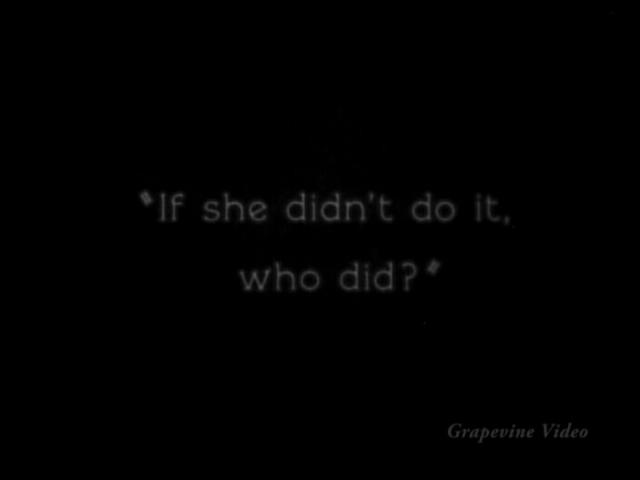
Griffith cuts to the chase - a direct question to the first man he sees
If not you, then who?!
Benchley at work...
Everyone seems to be a straight man in this film, working up their most suspicious expressions....
Sebastian squeezes out every silent screen era signal of guilt and confusion.
There is a lot of back-and-forth business where Griffith takes and returns the badge of inspector, indicating his level of confidence, both for solving the situation and for likely making it to the theatre before opening curtian.

.
Sebastian's hysterics at being told she has just seen a dead body
Thirty years later, in
Rear Window, Hitchcock would insert a series of expressionless shots of Jimmy Stewart and the audience would have different impressions of his emotional state based on what the reactive image would be - here, Sebastian holds the same stare, and Griffith's expression gradually transforms:
The coroner decides he must interview Ms. Sebastian in private.
Another direct question
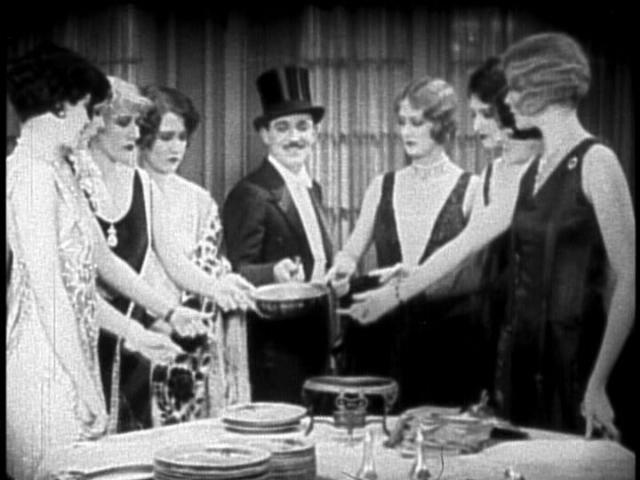
The staging in this shot is quite nice, arms thrusting inward to touch the chafing dish.
The wounded hand is a ruse, of course, quickly uncovered.
Of course, that's a cue for the cat and a crashing glass globe to center stage.
A suspicious face from above....
And all try to flee through the room containing the first victim's body.
The victim's cuff reveals a smudge clue - a distinct fingerprint!
The lights go out and the cuff vanishes...
The lights go out and the collection of probable suspects vanishes
The cuff appears, but a pointed comment appears as well...
Wherever Griffith bends to the door, the knife instantly appears at that spot. Nice comic timing.
And then a LOT of cuffs appear...
In comes what appears to be a butler, but is also the human connected to the face in the skylight...he wanders through the scene, rather nonchalantly...
This is a good place to interject some contemporary notes on You'd Be Surprised, from Loew's Weekly of 1926:
"Laughs 'n Gasps Galore in Gay Griffith Farce"
"If you want to laugh one minute and gasp the next - see Raymond Griffith in
You'd Be Surprised, which comes here next week. It is undoubtedly Griffith's best picture since his
Paths to Paradise. As a "Sherlock Holmes" Ray goes through mental gymnastics in the untangling of a murder mystery which would do credit to any sleuth.
"It's hard to say which the picture contains more of -- laughs or thrills. Griffith, a coroner, tries to discover who killed the district attorney. Instead of solving the mystery he finds himself in the center of a dozen others, and also discovers that he has fallen in love with a girl whom everyone suspects as the criminal.
"The picture's ending will have to remain a mystery because Mr. Griffith has asked those who see the picture to refrain from telling their friends the real murderer's identity.
"Dorothy Sebastian, playing opposite Ray, makes a lovely foil for his emotions. Earl Williams enacts the deputy district attorney, and Edward Martindel, the attorney. Arthur Rosson, the director of
Wet Paint, was again at the helm.
Some of the deaf mute scenes in
You'd Be Surprised are among the funniest ever filmed."
Besides referring to Raymond Griffith as "Ray," this promotional piece shows some disconnect with the actual production - Martindel plays the houseboat millionaire, not a district attorney, nor is there a deputy district attorney character in the film. Perhaps the publicity was early in production, before the plotlines were completely worked out.
Paths to Paradise is available from Grapevine, but with a missing final reel (the film seems to end abruptly, but the general narrative is still understandable);
Wet Paint seems to be among the legion of "lost films."
And the butler is deaf, and Griffith manages to communicate with him as the "coroner's jury" is brought into the main room. It's an enthusiastic scene, but not one at the level of hilarity described by the studio's promotional material....
The assembled coroner's jury, namely whoever would be walking the streets at night near a houseboat, is sworn in.
Griffith accommodates the jury by having a makeshift dinner.
The butler, now the coroner's assistant, will stand in for the first victim as Griffith tries to recreate the crime for the coroner's jury.
... with the same results...
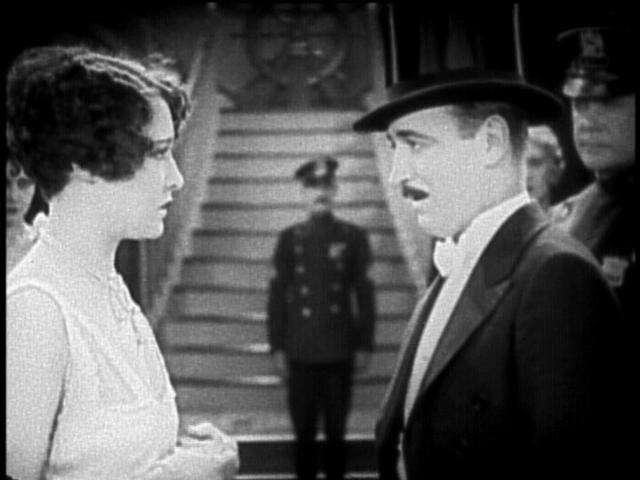
Things aren't looking good for Sebastian with this exchange.
Pure Benchley
So even Griffith offers to take the place of the first victim for the re-enactment.
The jury frets for his safety...
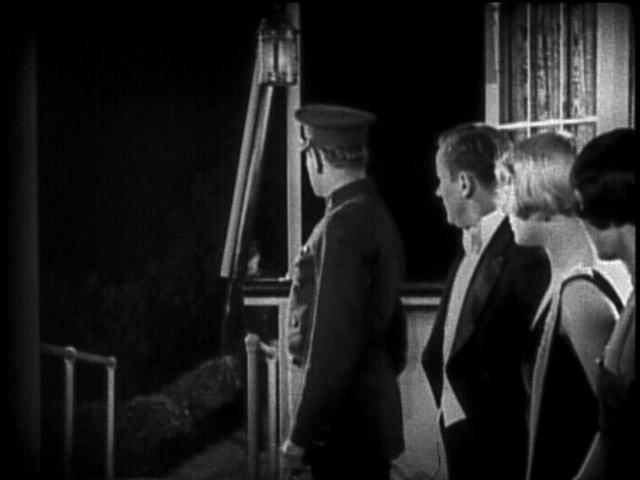
The police won't permit a complete lights out!
The jury is dismissed at this latest twist in the case....
And Griffith has been among them the entire time.
The man's thumbprint matches the one on the purloined cuff....and it turns out it was the first person Griffith accused, 40 minutes earlier!
"How'd you do that!?"
And, suddenly, Richard Arlen, a year from starring in Paramount's Wings, shows up as a reporter!
For more information about Raymond Griffith, a good place to start is the 1975 book by Walter Kerr,
The Silent Clowns in the chapter (#31 in the series!) entitled
The Unexpected Raymond Griffith. Griffith's career didn't survive into the sound era due to damaged vocal chords that didn't permit him to speak above a whisper. His last role before the camera was as the dying soldier sharing a foxhole with Lew Ayres in 1930's
All Quiet on the Western Front. He produced comedies through 1940, even serving (uncredited) as an electrician on
The Wizard of Oz (!!!).
In addition to
You'd Be Surprised, other films that remain available with Griffith also include
Hands Up! and
Paths to Paradise, where he stars, and
White Tiger, Changing Husbands, and
Miss Bluebeard, where he appears in secondary roles (all from Grapevine Video).






 .
.