Showing posts with label buster keaton. Show all posts

Friday, August 16, 2024

Post 693 - "The General" Novelization - 1927

Small town libraries don't seem to be the repositories of history any more.  The digital push brushes past tangible artifacts that have slipped from the thin vapor of memory and are no longer deemed significant.

This afternoon I found a volume in the local library's "discard bin."  It may have been remaindered from a local estate sale, it may have been donated and rejected for fund raising purposes.  

The title immediately caught my attention, having recently attended a showing of the Jim Schaub/Ron Pesch documentary, Keaton:Home in Muskegon.  The General is frequently cited among the best silent films ever made, and in terms of comic timing and visual composition, a likely contender as one of the best films ever made in any category.  

I never heard of the author, Joseph Warren, and opened it, expecting to see the exploits of some European count or Great War honcho.  Instead, the cover page told a completely different tale - The General was a contemporary novelization of the 1927 Keaton masterpiece, an expensive epic that, to jazz age eyes, wasn't all that much to get enthused over (the Raymond Griffith film Hands Up! had better reviews), with the dark humor of the battle scenes regarded as positively repelling.   

I'll be scanning the pages in the days ahead to preserve this version of the film, lest my own eventual estate sale be equally incapable of finding the original volume a proper, appreciative custodian.


Thus far, I have only come upon one other novelization by Joseph Warren (of Long Island, according to his prologue to The General): What a Widow! was a novelization of an early Gloria Swanson talkie of the same name in 1930.  Will continue to explore the rabbit hole!

undefined 

(note her producer's name) 


Click here for The General (archive.org 4K file - if it takes too long to "fire up" you can just download the file and enjoy it when and where-ever you wish!)

Sunday, March 12, 2023

Thursday, April 01, 2021

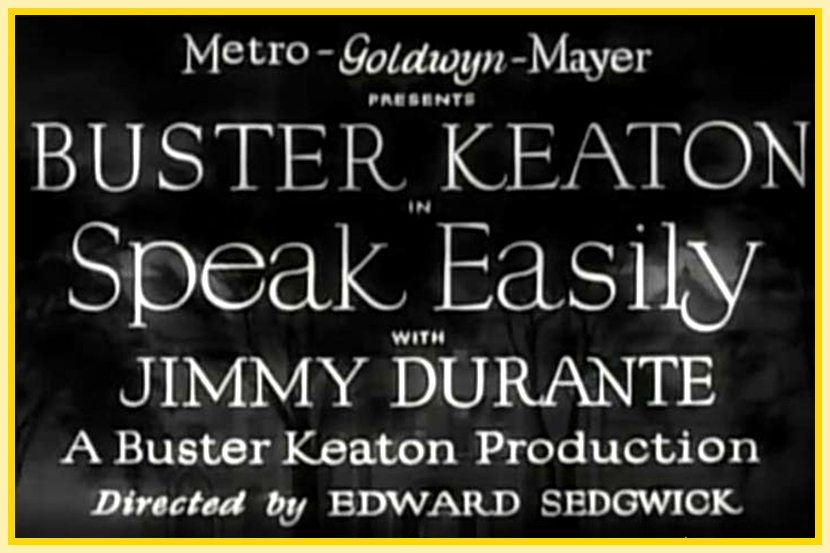
Post 405 - Speak Easily - 1932 - Editing Exercise - Sequences 11 and 12 blend for The Climax and We're OUTTA HERE!

At times, portions of the final section of Speak Easily seem to predict the climax of A Night at the Opera, with Keaton swinging from the rafters across the stage.  Originally, it ran like this:


The class went nuts.  Armetta was out! OUT! and Keaton needed to have a tighter focus and not drag out his time on the diorama.  In addition, an editing continuity had them rerunning the sequence where he stumbles from the catwalk, apparently on the right side of the stage, and then swings onto the stage from the left.  Using the miracle of digital editing, that was adjusted as well.  And who puts a fade out in the middle of a comedy climax!?!?


And whoosh! It is over at last.  

While 20:20 hindsight is always an easy thing, we cannot fault everyone involved in the production of Speak Easily with its shortcomings, but we can use it as an exercise on how not to put together a comedy.  By today's tastes, Speak Easily doesn't hold up very well, but we must remember that in its 1932 release, it made more money than any of Keaton's silent films ever did.  So like Pixar and its Cars series, MGM felt it was making the right decisions based on what truly mattered to Louis B.  and Irving T.

1932 - 8 minutes, 2 seconds

2021 - 6 minutes, 25 seconds

The complete, entire original film - 81 minutes 

The class edit project final length - 72 minutes

Next we're going to work on either Intolerance or Gone with the Wind.  Or perhaps invest in a popcorn machine.

Complete assembly of the Speak Easily "Redux"  is on archive.org -- 

Speak Easily Redux 


Post 404 - Speak Easily - 1932 - Editing Exercise - Sequence 10 - The First Act

And so it begins - the show starts, Keaton reels from a sincere kiss and things start falling apart.  A face in the crowd is targeted as someone really enjoying the show.  At first, we all thought it was the university butler in attendance at opening night, but it is actually one of the show's backers.  It seemed odd to introduce him so late in the proceedings.

Keaton has a nice slide onto the stage, Durante does one of his specialty songs (which he was still doing on the Mike Douglas Show in the 1960s), and Thelma Todd gets covered in bleached corn flakes.  The sequence doesn't really build, but there it is:


Nobody really cared for Henry Armetta here, either.  I told them to check out the Marx Brothers' The Big Store someday, where the producers thought they needed a "funny Italian" (apparently Chico wasn't a comedian to them by that time in his MGM career).  Regardless, he was trimmed.  


In 1932 - 8 minutes, 22 seconds.

2021 - 6 minutes, 58 seconds


Post 403 - Speak Easily - 1932 - Editing Exercise - Sequence 9 - Opening Night

Speak Easily has been building up to this point.  Unlike A Night at the Opera three years later, the show is supposed to go on, and we're supposed to hope for the best with this collection of wandering vaudevillians and a befuddled professor.

Cross your fingers!

The original ran thusly:


And the project produced this version:


1932 - 6 minutes, 35 seconds

2021 - 5 minutes, 56 seconds


Post 402 - Speak Easily - 1932 - Editing Exercise - Sequence 8 - Fixing the Situation

The sequence begins with a Durante caricature with his nose protruding downward at a specific angle.  It comes at a reel change, so it is extended by Durante's laugh over the image.  Now think how Keaton was positioned in the shot immediately preceding this one.  I think a fade in/out transition was chosen instead of a lap dissolve for a reason.


Of course it leads to a possible compromising situation, and the troupe has now learned the truth behind the professor's inheritance, so it's time for a nice switcheroo.  And a few trims, because by now everyone was on a roll.


1932 - 6 minutes, 20 seconds
2021 - 5 minutes, 45 seconds

Appendix - here are the screen shots of the end of sequence 7 and the start of sequence 8, with a simulated midpoint of a slow lap dissolve of the two, had the transition been performed in that manner - 


Oh that persistence of vision!

Post 401 - Speak Easily - 1932 - Editing Exercise - Sequence 7 - The Awkward Seduction

Considering the chemistry that Thelma Todd had with the Marx Brothers in Horsefeathers, also from 1932, it is interesting to compare her scenes with Keaton with those of Groucho. Chico, and even Zeppo.  It doesn't help that this is a drinking scene, and perhaps something other than tea had been placed in the decanters.  Todd's reactions are great, nonetheless, if somewhat lost in the medium shots.  And Spite Marriage is used again for material, however briefly, in getting her to stand up near the end.

What rhythm the scene has is broken with the extended insert of the cuckoo clock, no matter how clever the swirling effect, and the class agreed that one clumsy backflip over the sofa was quite enough.  So out came the scissors, and everyone had fun resizing those master shots!


We also noticed something very odd about the staging of Keaton in bed at the end of sequence 7, especially in context of the way sequence 8 begins.  But that's another entry in this never-ending series!

1932 - 8 minutes, 40 seconds
2021 - 7 minutes, 29 seconds
Oh, if only diets were this easy!


Post 400 - Speak Easily - 1932 - Editing Exercise - Sequence 6 - The Rehearsal and Paying Rent

The rehearsal is centered around Durante and Toler, and somewhere along the line, someone (possibly the film's editor) noticed that the film's star was missing.  Thus the insert shots appear of Keaton, with a neutral background, looking interested in the goings on and saying nothing, so when he does appear near the end we get the impression he has been in the rehearsal room the entire time.  The "Singing in the Rain" gag is still cute, and was featured in the compilation film, That's Entertainment (1976).


Of course we had to snip here, and there:


In 1932, it ran 6 minutes, 30 seconds.

In 2021, 5 minutes, 59 seconds.


Wednesday, March 31, 2021

Post 399 - Speak Easily - 1932 - Editing Exercise - Sequence 5 - Broadway Bound and Down to Business with Thelma

Despite Durante's brash presence, he brings the picture a splash of welcome energy with a bit of his anthem, "Can Broadway Do Without Me?"  and his march through the hallway to his new business office.  This is followed by a bit of stock footage pulled from King Vidor's 1928 masterpiece, The Crowd.  The rest of the scene is dominated by Sidney Toler, known at the time as a Broadway comic actor, but destined to be remembered for his later portrayal of Charlie Chan at 20th Century Fox and Monogram pictures.  Then Thelma Todd arrives, full of tough charm and hard-boiled agendas.


Most of the changes here are for staging - again, to adjust for the dark set and master shot mentality of MGM's misunderstanding of comedy.  


1932 - 7 minutes

2021 - 6 minutes, 58 seconds


Post 398 - Speak Easily - 1932 - Editing Exercise - Sequences 3 and 4 - To the Show! and The Professor Saves the Show!

TO THE SHOW!

Sequence 3 of Speak Easily is one of the smoothest of the film.  It begins with goodbyes at the station, with Keaton getting mixed up with Jimmy Durante and then getting on the wrong train - the shot is one of the best composed of the feature, with Keaton staring ahead, while his departing train can be seen through the doorway behind him.  He is for a fleeting moment, a contented statue.

The banter with the station master is a well performed give and take, for as short as it is, followed by an undercranked ride in a jalopy.  Keaton is deposited in front of the opera house and, like his 1929 feature Spite Marriage, we get to see the troupe's performance before it is later disrupted by Keaton's inclusion.  


Very little needed attention here, a relief from the earlier sequences - however, we decided that some of the shots could have been tighter, in order to emphasize the action over the audio.  We let it stay "as is."

THE PROFESSOR SAVES THE SHOW!
Sequence 4 gives the professor a chance to play hero to the troupe with his new-found "wealth."  It, too, was fairly smooth, but the class found a few things to trim after repeated viewings.

From 1932:

The class was noticing that Keaton appeared not necessarily clumsy by character, but unsteady.  We discussed his drinking problem that was accelerating during this production, and that multiple takes were probably not always an option.  If you get the chance to watch his second release of 1932, What, No Beer?, you'll find that his appearance is pasty and disheveled, his delivery hoarse, and he often seems unsteady on his feet.  This film has a few episodes of this, but he nevertheless used to refer to Speak Easily as one of his favorite of the sound MGM releases.  This is likely because his studio-abused character of playing a clumsy simpleton was at least fairly consistent here in the role of a slightly-foggy professor.

So, after a little trimming, this version for the editing project emerged:


The original sequence  ran 4 minutes, 45 seconds.  The edit came in at 4 minutes, 20 seconds. 


Monday, March 29, 2021

Post 397 -Speak Easily - 1932 - Editing Exercise - Sequence 2 - The TRAIN

The first sequence was a warm up for this class project to play with the 1932 Keaton film, "Speak Easily."

Once the Professor has been informed of a $750,000 inheritance, he is off to seek companionship and rub elbows with the common man.  Instead, he encounters Jimmy Durante and an impoverished vaudeville troupe.  I ran the clip from the original film, and then we made suggestions based on what we saw.  To be honest, I had already made the edit for this portion, but the students were a savvy lot and they identified nearly everything destined for the cutting-room floor.

Here is how it ran in 1932:


One line everyone seemed to like was, "I'll tell it to the guy with the face."  Other than that, the questions were, "What does the baby have to do with anything besides being a prop?  Can we get the baby to stop crying? Why does Jimmy tell the joke twice?  Why does the professor have to repeat 'equivocate'? Why can't we get more camera movement? Why aren't there second takes when lines get muffed or talked over?  Was this when Keaton was drinking? Why are they going on past the best line to close a shot?"  

During this sequence, the audience learns that the inheritance was a ruse by the professor's butler (well, a shared butler, I guess...what kind of college is this?!?).   His confession is staged in another cavernous set at a college where buildings are 50% higher than they should be to accommodate the high ceilings.

So I showed them my edited version, and they suggested further cuts and resized shots which were then incorporated:


The 1932 scene ran 10 minutes, 36 seconds.  The edited version came in at 8 minutes, 34 seconds.  Already we have trimmed about a third of a reel!  It won't be the last time Henry Armetta gets his underwritten and overacted part trimmed in the course of this project.

Sunday, March 28, 2021

Speak Easily - 1932 - Editing Exercise - Sequence 1 - The Set Up

There are the ruins of a good comedy in the penultimate Keaton feature for MGM, "Speak Easily."  Released in 1932, it has the typical overwritten, over-explained plot of his "talkies," often more noise than humor.  I turned it over to my students in a dozen sequences after discussing film editing, use of close-ups, tightening action, and knowing when to end a scene.

Here is sequence #1 of the film, as released by MGM.  It has gone into the public domain, so that was the main reason I chose it for the exercise:


The group working on this sequence first noted that, since it is immediately established that this is taking place on a campus, why bother with the extra expense of hiring two mediocre actors to portray students?  They don't add anything, they aren't in the least bit interesting or funny, so cut them out!  
"Is this how some producers got their kids into movies?  Parts like these?" 

Next came the overuse of master shots, in some cases making the cavernous set the emphasis, instead of what is going on.  This is supposed to be a poor professor, but he has a huge apartment like this?
  
Using a video editor, master shots became medium shots, action was tracked with the camera to add emphasis to the movement, and insert shots were incorporated, again to heighten the motivation of the butler as he produces his letter to the professor, which ultimately proves to be fake.  
Insert shots also allow for the cutting of a second here, another there.  Nothing is lost for the sake of the scene, but the overall effect is to keep the action moving.

Finally, they decided that the scene should end with "I'll buy companionship!" referring to the Keaton character's need for friends as he hurries to pack.  The action that followed seemed more bungling and incidental than funny.  End with the joke and get out!

So their Sequence #1 came out as this.  The public domain source had some inherent flaws with the print quality, so expanding the frame created some fuzziness that wouldn't be present in a proper production.


The original clip ran 6 minutes, 20 seconds.  The students' version ran  5 minutes.  The group liked the sense of instant gratification with digital editing and were pleased that it started the film off with less exposition.  

They had even more fun with the second sequence.


Sunday, March 15, 2015

Editing Keaton Exercise - Doughboys (1930)

Keaton at MGM is one lesson after another in how that venerable studio just couldn't fathom comedy and comic timing.  So many things framed as a master shot, so many jokes overexplained verbally and then visually...it's great raw material for an editing exercise.

The original clip:


And after some mild trimming:


Just like his later film, "Speak Easily," there is a pretty good movie hidden in "Doughboys."