Showing posts with label movies. Show all posts

Monday, February 17, 2020

Hey, I'm trying to sleep here!

   
     Well, the latest reverie was me being inserted into an intervention led by Nick Nolte and a Keanu Reeves-ish counselor for a suicidal Gary Busey.
     Nolte tells Busey, "Hey, you've got all your fans to think about - they loved you in...." and he turns to me and says, "Quick! A Gary Busey movie!" and nobody can think of one, including Busey...
     Nolte gets Busey's gun, we all run out into the night and end up over a bridge where Nolte accidentally shoots the gun into the dark, and says, "Oh that's harmless," and immediately there are sirens, an upended vat of red paint is mistaken for blood, and a crowd of people run out into the street and onto the bridge.
     Then, a block away, a deserted building explodes, and we surround Nolte, still holding the gun, afraid to toss it because of all the witnesses, and unwilling to hide it in his pants because the barrel is still hot from the firing.
     Then someone yells "CUT!," and Sparrow demands to be let out.  
     6:45am.  
     So much for retirement.

Monday, January 14, 2019

Christmas Movie Memories from 2018 - The Holly and the Ivy (1952)

Couldn’t make it all the way through “The Holly and the Ivy” on its Turner broadcast, even with a mild distraction of a jigsaw puzzle. It began interestingly enough, with some banter among two ladies trying to share the same train compartment, but having to adjust for one’s first class vs second class carriage, setting the stage for a class division between them. Then it comes to Ralph Richardson’s house and becomes a completely set stage. Lots of quiet talk, quiet outrage, quiet disappointment, restrained dismay, revelation of atheism as The Holiday service approaches, and an overarching impression that father has been more interested in his career than his own family. He prefers the abstract assistance over the concrete concern, seems mildly surprised that his family has all these stressors. Ultimately, Michael Gregory chucks it all to go to America, changes his name to Marcus Brody and becomes dean of students for Marshall college in Connecticut, only to be sobered up and perpetually frustrated by one of his professors, Henry Walton Jones, Jr. At least that’s what I remembered. The egg nog that evening was fantastic.  Sparrow agreed.


Friday, October 19, 2018

Marx Brothers, Streamlined - ongoing project


Their last group picture - Harpo, Zeppo, Chico, Groucho, and Gummo


They're practically part of my DNA, these four brothers, but I'm enough of a fan to appreciate that some of their films are challenging, and in the case of two of the MGM productions, not at a level I can share in public venues due to their 1930's-level of "appreciative stereotyping."
So.  I am working with the former Sony Vegas software and mp4 versions of their 13 films to do the unpardonable - I'm editing down Marx Brothers movies.
Many of them.  Some remain perfection on celluloid, and some (such as "Horse Feathers") could go on for another hour as far as I'm concerned. 
So, trimming out and adjusting pacing have given me the following projection times:


1929 - The Cocoanuts (the Cocoanut "reduction") - from 96 to 78 minutes - most of the cuts involved excision of the songs "When My Dreams Come True" and "Monkey Doodle Doo."  "Monkey Doodle Doo" has a lot of fun lyrics, but my ears cannot take the performance. 


1930 - Animal Crackers - 98 minutes?  Make it 398 minutes - recreate the DuBarry scene, in synthetic 2-strip technicolor, please!  And someone find Lillian Roth outtakes, too! Or find "Madame Satan" and try some fancy editing.


1931 - Monkey Business - 77 minutes, still 77 minutes.  Love the opening credits - would have loved the ending to be in the original warehouse for the bootleggers - then it could have ended with the four barrels full of Marxes ready for their next adventure.


1932 - Horse Feathers - 68 minutes - oh please, some archive find and restore the apartment scene with Thelma Todd, and the extended dog catcher sequence.  I know I saw it complete when a mere tad on an episode of "Wayne and Shuster take an affectionate look at The Marx Brothers" in the 1960s.


1933 - Duck Soup - 68 minutes to 67 and 1/2 minutes - to permit showing at my current venue, I had to excise "...and that's why darkies were born."  Nobody understands George White's Scandals anymore in academe.   At the age of 4, this film taught me perspective - how did those tiny guys squeeze into the family's 19 inch Motorola b/w?


1935 - A Night at the Opera - 92 untouchable minutes - unless someone finds the excised references to Italy that MGM carved from the ORIGINAL NEGATIVE.  MGM does NOT "get" comedy. (OK, they could trim the part where Groucho gets kicked down several flights of stairs, but that's also for another movie..)


1937 - A Day at the Races - 109 minutes down to 90 minutes - that Gabriel scene had to go, along with some other unnecessary exposition - the MGM bricks were falling on the brothers.  Much of the water carnival went to the editing bin, too.  The Sneaky Dragon podcast is spot-on in identifying the dogpile of plot errors that the MGM chefs stirred into the project fleetingly known as "Peace and Quiet."


1938 - Room Service - 78 to 72 minutes - just trimmed out dead air - it seems slightly perkier.  The background dialog between Groucho and Chico while Harpo mastered the layered look lost all the dead space, and with the miracle of compression, I kept everything Harpo did, but about 20% faster.  A second set of great opening credits that will be unscathed. Near the end, when everyone is being so solemn around the author's fake suicide, you really notice that this isn't the usual Groucho - there'd be one zinger after another if it had been "Animal Crackers."  I have never seen the original play performed onstage...it may be more than somewhat dated, to judge by this performance.  Ann Miller is barely 15 here?


1939 - At the Circus - 87 minutes to 63 minutes - Out with Swingali, of course, but my stomach could not take any rendition of "Two Blind Loves," and it was an opportunity to slice back on Groucho's scene with Goliath.  Still couldn't do much with the continuity gaffe where Groucho suddenly appears on the train after being completely blocked by Chico at the station.  Best scene is still Harpo and Chico with Goliath, and the ending with Jardinet's orchestra floating out to sea remains intact and satisfying.  Wouldn't this film have been better if "Lydia" had been sung in the excised courtroom scene with Groucho, have Groucho run to the train after Chico's telegram, dive into a cab with Margaret Dumont, and then have Chico do a version of "Lydia," and then have Harpo do a version as well...in the meantime, there is the fine edit by Bob Gassel of the Marx Brothers Council that can be sought out with some work.  He moved Chico's solo to the final third of the film and completely sliced out the ending circus "climax." He calls his versions "Paramount cuts" and even finds more appropriate title music in the process.


1940 - Go West - 80 minutes to 68 minutes - the temptation to slice out all except the opening and closing was strong, but I wanted to test how to do internal edits, such as speeding up the closing gag of the railroad official sliding into a prepared hole after he gets clobbered.  I may do another version, cutting out the reservation scene and putting back in "Ridin' the Range" - it would be a nice thing to think of the Kalmar and Ruby script - with "Go West" at the beginning, and Chico and Harpo being a pair of spies sent out to help Mr. Beecher with his greasy plans, so there could be a "Duck Soup-ish" spy update scene. 


1941 - The Big Store - 83 minutes to 60 minutes - that "Tenement Symphony" is toast, and the bed scene is distilled to a single joke.  At 60 minutes, it amounts to some adequate Groucho time, and lots of music by Chico and Harpo.  I actually like "Sing While You Sell," with the Marxes making a transition to the 1940s-style of musical comedy, and Groucho can dance.  Gassel's cut completely eliminates the entire generic chase scene, which is totally in-Marxian and what is even more shocking, isn't missed a bit!


1946 - A Night in Casablanca - pending - maybe an opportunity to play with the pacing.  But the Marxes prove they could do better than Mervyn LeRoy at producing a Marx Brothers comedy.  Deleting a pair of comedy scenes after the premiere, as read by the makers of the Sneaky Dragon sidecast "Full Marx," was utterly unforgivable, however.  Imagine Groucho running a desert hotel with a departing guest and his harem...and an extended scene with Chico talking about the camel taxi business...aaugh!


1950 - Love Happy - an earlier experiment took the 85 minutes down to 60, but I'm looking for better pre-edit material (the Marilyn Monroe sequence is far too dark in my work print).

This exercise is distraction is an extension of my experiments with the MGM Buster Keaton films.  With all the excellent raw material, even with Keaton's decline (horrifying in "What, No Beer!"), much better films should have emerged.  My video editing class showed that "Speak Easily" would have been a better, tighter film with the removal of about 6 minutes, and the consensus was that "Doughboys" (1930) would have been an ideal "part-talkie."  At class end, we had experimented with using "live" sound over a 20fps hand-crank conversion in various parts, and Keaton's traditional timing began to emerge.  MGM couldn't wrap its head around comedy.  Imagine how W. C. Fields would have fared under the umbrella of Leo beyond his "David Copperfield" appearance...


Two excellent Marx Brothers podcasts are available -
The first is from the Marx Brothers Council, soon to have a 9th episode on their website - marxbrotherscouncilpodcast.com
and
The second is a "side cast" from Canada, from sneakydragon.com, with all 13 films being reviewed.  The Council has a theatrical background, influencing their favorites and their focus - Sneaky Dragon is hosted by a pair of comic writers who approach the films with a more cinematic perspective.  Both are fun diversions for prolonged periods of windshield time, and both have multiple social network platforms for conversations.


Saturday, November 11, 2017

Musings on Blade Runner 2049

Peugeot 2049, Masquerading as a sequel to Blade Runner

This is a long movie, so my first recommendation would be to get a medium sized popcorn, but add lots of salt to it, and then go with a small drink.  This will allow for some proper physiological water retention, so there won’t be a need for a bladder-based intermission.  This is a relevant factor, too, because despite the improved technology of today’s cinema, there isn’t a pause feature for a theatrical presentation, which insists on playing out in “real time,” although with the broadly-brushed panorama of Blade Runner 2049, watching it in real time would require an investment of several weeks.  This is one of the many advantages to film editing, as opposed to life living.

As a spoiler alert, this is another film where Robin Wright doesn’t fare well, but Harrison Ford at least manages to survive a relationship with his child.

And, considering that the original was supposed to be taking place 18 months from now, this version of my birthday number 94 seems logical.  However, L.A. isn’t quite to the 2019 level of drenched decay as the original 1980s movie predicted.

But isn’t that the function of science fiction, and for predictions of dystopia?  They are supposed to accelerate the likelihood of the predicted event as a form of “Wake Up” call to the probability of an unfortunate future... 1984 was premature by a generation, The Day After Tomorrow collapsed a decade of climate disasters into a two-week period, so it is that a film like Blade Runner 2049 is giving us the warning not to invest in San Diego property, because, frankly, San Diego is going to be one dumpy place.

There is an aside reference to a “Great Blackout,” an event that rises for unkown reasons but seemed to have had a major impact on digital information.  This is something we’ve been anticipating since the overwhelming dependence on the internet, making a linerar existence without it seem unimaginable.  So imagine it.

Need a typewriter?  See me after the Great Blackout.

As to the performances - Denis Villeneuve brings a large amount of humanity out of beings that are supposed to be completely subservient or totally digital.  It creates the question on the humanity of the supposed humans in that society, the reverse-abuse from a Lieutenant of the LAPD or the bloodlust of the manufacturer of the latest wave of replicants.  Even the sinister “Luv” belies her name again and again, but can still elicit a child’s contentment at the prospect of “going home.”

Sean Young, a la Carrie Fischer and Peter Cushing, reprieves her Rachael in cameo, but 30 years cannot be masked to the satisfaction of the producers, so a performance double is used, and quite smoothly, too.

In summation, 2 hours and 40 minutes, watch the drinks, watch the screen.  Quite the ride, but one we will probably push off until 2100, if we are all lucky...

(so of course I went out and found the original Blade Runner after watching the sequel - the VHS copy is a shredded mess and this DVD version is New! Improved! with More Kelp!)

Sunday, March 27, 2016

An Appreciation of Raymond Griffith - You'd Be Surprised (Paramount, 1926)

Along the lines of Richard Anobile:

First of all, my thanks for Grapevine Video, about the only available source for Raymond Griffith's films, for making these films available to current audiences.  Check them out at www.grapevinevideo.com for many obscure titles that have been overlooked by others and have slid into the public domain...this particular DVD release is from a very good master print.

"The most difficult, the most delicate, the most interesting, and a very worthwhile job is that of making people laugh."  - Raymond Griffith

Nice features of the Paramount comedies of the 1920s include the opening credits.  There's a lot to look at with the title - here, the now-forgotten Raymond Griffith gets a full star credit, the Paramount Logo is re-established, the location of the production is confirmed (here, the West Coast, vs the East coast, where productions tended to pull talent from New York), B. P. "Bud" Schulberg is at the helm, and the sinister eyes seemingly as an afterthought, (one could wonder if the original production was misinterpreted as something far more dramatic by the title artist, or that by 1926  the image was such a cliche that it foretold a tongue-in-cheek adventure?).

Here is where things quickly became interesting - by 1926, Robert Benchley was an established critic for Vanity Fair and had three volumes of essays to his credit.  His "Treasurer's Report" had been a Broadway staple for some time and Jesse Lasky approached him to write screenplays.  Not much seemed to come of this arrangement, but for You'd Be Surprised and two other Paramount films he did create the text for the title cards.  This predates his own film appearances in The Treasurer's Report and Sex Live of the Polyp by two years.

Arthur Rosson comes to You'd Be Surprised after completing another Raymond Griffith film,  Wet Paint, and a Bebe Daniels film, Stranded in Paris.  He appears to have been a Paramount mainstay, with credits often intersecting with Cecil B. DeMille as a second unit director.

Another familiar name to film fans of the silent era is Dorothy Sebastian, known for her relationship with Buster Keaton and appearances in his films Spite Marriage, Free and Easy, and  Allez Oop.  


You'd Be Surprised plays out in real-time, in only three staged rooms.  The image of the gigantic houseboat above is the only real exterior shot in the movie, and the use of an evening time frame further trims narrative expense.  While it is a slickly made film, it was likely a comparatively inexpensive production for Paramount.

The film begins with a montage sequence stressing that an unlucky evening about to unfold.

Phonograph fans will quickly recognize the collectible dancing toy. a variation on "Ragtime Rastus." It linked to the turntable and, through gears beneath the device, made the toy dance.  Other toys had a couple dancing the waltz or tango.

The cat continues its wanderings in the houseboat, with disasters in its wake....
Dropped bracelets...
A lost hand at cards...
A dropped compact, with resulting broken mirror...
But best, with a tete-a-tete being interrupted by the arrival of a wife...all in below-the-knee perspective...


And then, for a finale in this opening montage, a tap on the film's first victim.


Well, that pretty much telegraphs in what's about to happen.


And out the lights go...


That's character actor Roscoe Karns in the tuxedo.  Known for his wise-cracking rapid banter in later movies, it's interesting to see him here in a silent film,

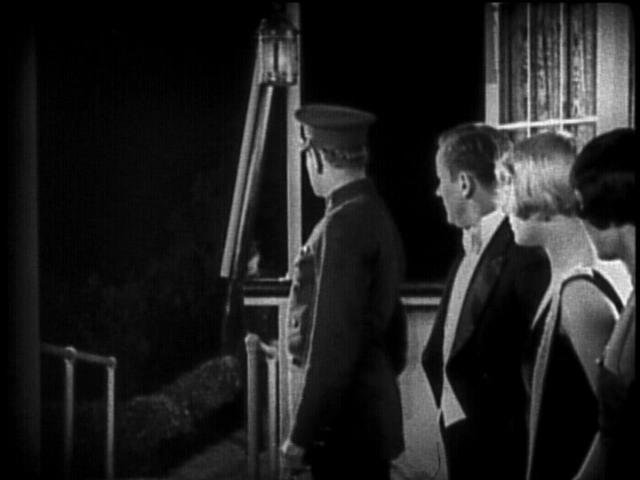
With the elevation of each arriving dignitary, the announcement becomes increasingly formal, but each time the verdict is the same - "Don't touch anything! This is a case for the coroner!"


And with that, the staging is set for the arrival of the star of the program, the coroner, preceded by the black cat -- Raymond Griffith.  It's prescient to Groucho's arrival to head up Freedonia in Duck Soup, 7 years later...


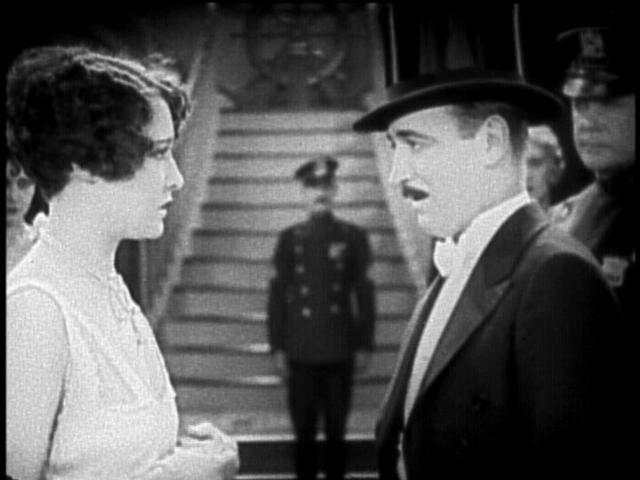
Griffith cuts to the chase - a direct question to the first man he sees
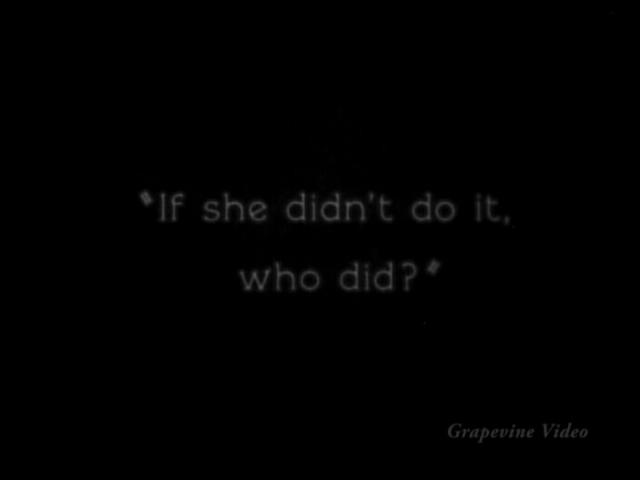
If not you, then who?!


Benchley at work...


Everyone seems to be a straight man in this film, working up their most suspicious expressions....


Sebastian squeezes out every silent screen era signal of guilt and confusion.


There is a lot of back-and-forth business where Griffith takes and returns the badge of inspector, indicating his level of confidence, both for solving the situation and for likely making it to the theatre before opening curtian.


.

Sebastian's hysterics at being told she has just seen a dead body


Thirty years later, in Rear Window, Hitchcock would insert a series of expressionless shots of Jimmy Stewart  and the audience would have different impressions of his emotional state based on what the reactive image would be - here, Sebastian holds the same stare, and Griffith's expression gradually transforms:


The coroner decides he must interview Ms. Sebastian in private.


Another direct question


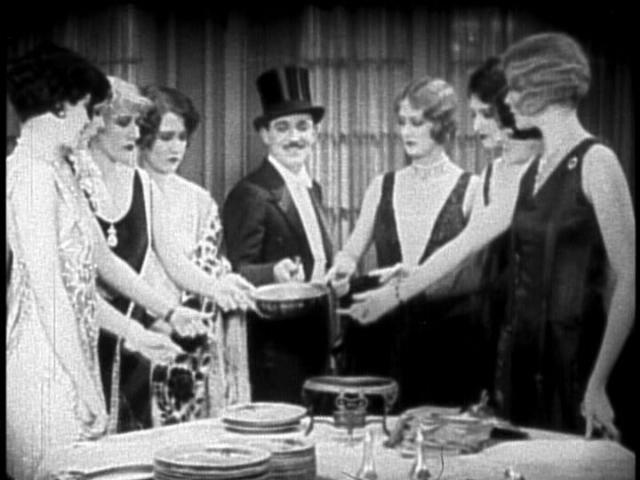
The staging in this shot is quite nice, arms thrusting inward to touch the chafing dish.


The wounded hand is a ruse, of course, quickly uncovered.


Of course, that's a cue for the cat and a crashing glass globe to center stage.


A suspicious face from above....
And all try to flee through the room containing the first victim's body.


The victim's cuff reveals a smudge clue - a distinct fingerprint!


The lights go out and the cuff vanishes...


The lights go out and the collection of probable suspects vanishes


The cuff appears, but a pointed comment appears as well...

Wherever Griffith bends to the door, the knife instantly appears at that spot.  Nice comic timing.

And then a LOT of cuffs appear...

In comes what appears to be a butler, but is also the human connected to the face in the skylight...he wanders through the scene, rather nonchalantly...

This is a good place to interject some contemporary notes on You'd Be Surprised, from Loew's Weekly of 1926:

"Laughs 'n Gasps Galore in Gay Griffith Farce"

"If you want to laugh one minute and gasp the next - see Raymond Griffith in You'd Be Surprised, which comes here next week.  It is undoubtedly Griffith's best picture since his Paths to Paradise.  As a "Sherlock Holmes" Ray goes through mental gymnastics in the untangling of a murder mystery which would do credit to any sleuth.

"It's hard to say which the picture contains more of -- laughs or thrills. Griffith, a coroner, tries to discover who killed the district attorney.  Instead of solving the mystery he finds himself in the center of a dozen others, and also discovers that he has fallen in love with a girl whom everyone suspects as the criminal.

"The picture's ending will have to remain a mystery because Mr. Griffith has asked those who see the picture to refrain from telling their friends the real murderer's identity.

"Dorothy Sebastian, playing opposite Ray, makes a lovely foil for his emotions.  Earl Williams enacts the deputy district attorney, and Edward Martindel, the attorney.  Arthur Rosson, the director of Wet Paint, was again at the helm.

Some of the deaf mute scenes in You'd Be Surprised are among the funniest ever filmed."

Besides referring to Raymond Griffith as "Ray," this promotional piece shows some disconnect with the actual production - Martindel plays the houseboat millionaire, not a district attorney, nor is there a deputy district attorney character in the film.  Perhaps the publicity was early in production, before the plotlines were completely worked out.

Paths to Paradise is available from Grapevine, but with a missing final reel (the film seems to end abruptly, but the general narrative is still understandable); Wet Paint seems to be among the legion of "lost films."


And the butler is deaf, and Griffith manages to communicate with him as the "coroner's jury" is brought into the main room.  It's an enthusiastic scene, but not one at the level of hilarity described by the studio's promotional material....


The assembled coroner's jury, namely whoever would be walking the streets at night near a houseboat, is sworn in.


Griffith accommodates the jury by having a makeshift dinner.


The butler, now the coroner's assistant, will stand in for the first victim as Griffith tries to recreate the crime for the coroner's jury.


... with the same results...


Things aren't looking good for Sebastian with this exchange.


Pure Benchley


So even Griffith offers to take the place of the first victim for the re-enactment.


The jury frets for his safety...


The police won't permit a complete lights out!


The jury is dismissed at this latest twist in the case....
And Griffith has been among them the entire time.


The man's thumbprint matches the one on the purloined cuff....and it turns out it was the first person Griffith accused, 40 minutes earlier!

"How'd you do that!?"


And, suddenly, Richard Arlen, a year from starring in Paramount's Wings, shows up as a reporter!


For more information about Raymond Griffith, a good place to start is the 1975 book by Walter Kerr, The Silent Clowns in the chapter (#31 in the series!) entitled The Unexpected Raymond Griffith.  Griffith's career didn't survive into the sound era due to damaged vocal chords that didn't permit him to speak above a whisper.  His last role before the camera was as the dying soldier sharing a foxhole with Lew Ayres in 1930's All Quiet on the Western Front.   He produced comedies through 1940, even serving (uncredited) as an electrician on The Wizard of Oz (!!!). 

In addition to You'd Be Surprised, other films that remain available with Griffith also include Hands Up! and Paths to Paradise, where he stars, and White Tiger, Changing Husbands, and Miss Bluebeard, where he appears in secondary roles (all from Grapevine Video).